
Vathis & Associates — Real Estate Law | Noteworthy News
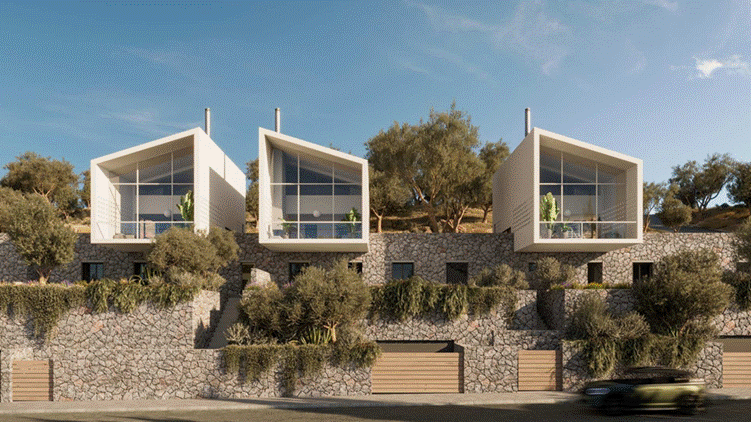
Three independent residences with sea views in Porto Rafti (indicative rendering).
I. Εισαγωγή: Όταν η επένδυση συναντά τον τρόπο ζωής
For many third-country nationals, acquiring a home by the sea in Greece is not merely an investment decision. It is the choice of a place to live, a retreat for the family and, at the same time, a stable base within the European Union. The Golden Visa programme allows these goals to coexist: the purchase of the right property can serve as the legal basis for granting a residence permit to the investor and the members of his or her family.
However, following the changes of recent years, the equation “beautiful home – Golden Visa” can no longer be taken for granted. A property may be excellent as a residence and, at the same time, unsuitable as an investment for the purposes of a residence permit. In this note we examine, with the help of a specific example, which criteria a seaside home in Attica must meet in order to serve both purposes safely.
II. The Current Framework: Investment Thresholds after Law 5100/2024
Under Law 5038/2023, as amended by Law 5100/2024, the programme has been substantially restructured. In the Region of Attica, the Regional Unit of Thessaloniki, Mykonos, Thira (Santorini) and islands with a population exceeding 3,100 inhabitants, the minimum real estate investment amounts to EUR 800,000. In the rest of the country the threshold is set at EUR 400,000, while the EUR 250,000 threshold is retained for special categories, such as the conversion of commercial properties to residential use and the restoration of listed buildings.
Two further requirements are decisive: the investment must concern a single property (the aggregation of several smaller properties to reach the threshold is no longer permitted) and, for residential properties, a minimum surface area of 120 sq.m. is required.
Porto Rafti, as part of the Municipality of Markopoulo Mesogaias in East Attica, falls within the EUR 800,000 zone. Consequently, any investor targeting a seaside home in the Mesogeia area or along the coast of East Attica must plan the investment on the basis of the higher threshold.
III. An Example: A Seaside Development in Porto Rafti
By way of example, we examine a development of three independent residences with sea views in Porto Rafti, with completion estimated within 2027. The area offers beaches with crystal-clear waters and easy access to Athens International Airport, making it suitable both for permanent residence and as a holiday home.
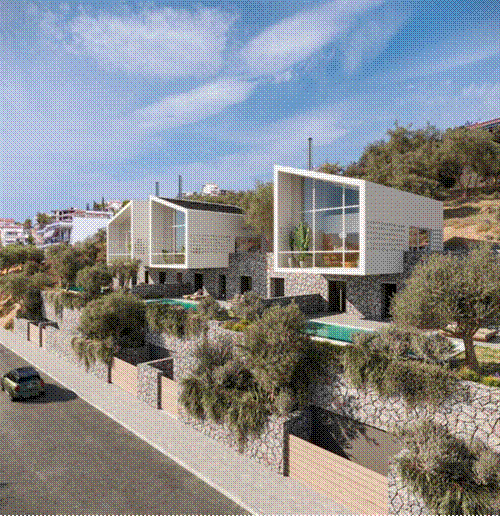
View of the development: each residence has its own garden with a pool and a private entrance at basement level (indicative rendering).
Each residence is arranged over a basement with parking and storage, a ground floor with two bedrooms, a first floor with an open-plan kitchen and living area, and a loft with a third bedroom. It features a private garden with a pool, A+ energy rating and a private lift.

First floor: double-height open-plan living area and kitchen with sea views (indicative rendering).
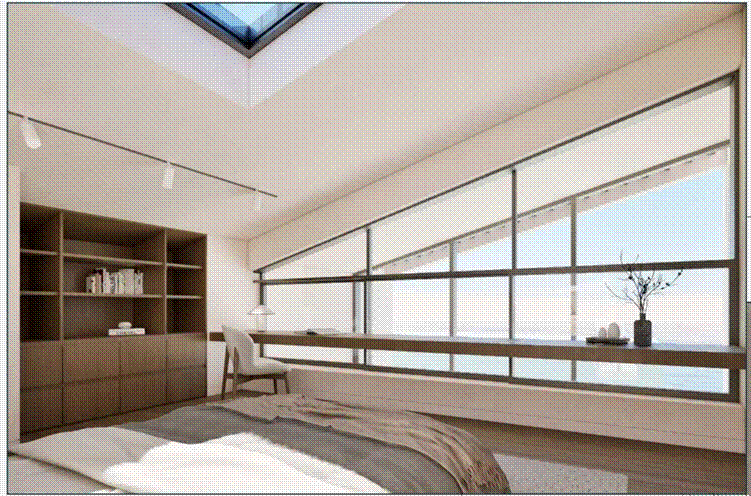
Loft: third bedroom with en suite bathroom and a panoramic window facing the sea (indicative rendering).
From a Golden Visa perspective, each residence constitutes an independent property and its main areas (189 sq.m.) exceed the 120 sq.m. threshold, while the required price is at least EUR 800,000. These requirements, however, are not sufficient on their own: before the purchase, the legal and planning compliance of the property and the timing of the application must be confirmed, as explained below.
IV. Legal Due Diligence of a Seaside Property
Seaside properties in Attica present particular features that are not encountered in a city-centre apartment. Before any commitment, the review should cover at least the following:
- Title deeds and Cadastre: review of the chain of title, the correct registration with the Hellenic Cadastre and the existence of any encumbrances, attachments or third-party claims.
- Planning compliance: review of the building permit, the conformity of the construction with it and, upon completion, the building’s electronic identity (ilektroniki taftotita ktiriou).
- Forest maps: in areas with olive groves and slopes, such as the hills of Porto Rafti, it is essential to confirm that the property does not fall within forest or reforestation land.
- Foreshore and beach zone: where the property is located near the coast, its position must be confirmed in relation to the officially determined foreshore (aigialos) and beach lines.
- Archaeological restrictions: the wider Mesogeia area is of significant archaeological interest, which may affect construction and future works.
Some of these issues, such as a planning violation or the absence of required certificates, may delay or prevent the execution of the deed itself. Others, such as an encumbrance or a third-party claim, may surface after the purchase and affect the value of the investment. Due diligence before any commitment protects the investor and ensures that the transfer, on which the residence permit application depends, will be completed without obstacles.
V. Buying a Residence under Construction: What the Investor Should Consider
Purchasing a residence that is still under construction, as in our example, offers significant advantages: modern specifications, high energy efficiency and the buyer’s ability to choose finishes. At the same time, it requires careful legal structuring.
The preliminary agreement or the contract for the sale of a future residence should clearly set out the construction timetable, the technical specifications, the payment of the price in instalments linked to the progress of works, the guarantees in favour of the buyer and the consequences of delay. In parallel, the point in time at which the investor will be able to apply for the residence permit must be considered from the outset, since eligibility is linked to full payment of the price and the execution of the required deeds. Furthermore, the sale of a newly built residence by a developer is, in principle, subject to 24% VAT. This VAT is currently suspended, in which case the 3% transfer tax applies instead. It must therefore be verified both whether the developer has placed the property under the suspension regime and whether the suspension will still be in force when the final deed is signed.
VI. The Prohibition of Short-Term Rentals
A seaside home with a pool may seem ideal for tourist rental. The current framework, however, prohibits properties acquired for the purposes of a Golden Visa from being made available for short-term rental, such as through Airbnb-type platforms. A breach of this prohibition carries strict sanctions, including revocation of the residence permit.
Long-term leasing remains permitted. Accordingly, an investor who intends to generate income from the residence when not using it personally must plan its use within this framework.
VII. Costs, Taxation and Tax Residence
In addition to the price, the purchase entails VAT or transfer tax, notarial fees, Cadastre fees and legal fees. On an annual basis, the owner is subject to ENFIA (property tax) and municipal charges, while income from long-term leasing is taxed in Greece.
For investors who intend to actually relocate to Greece, the purchase of the residence may be combined with the alternative taxation regime of Article 5C of the Greek Income Tax Code, subject to the conditions it sets. This decision requires comprehensive tax planning that also takes into account the tax legislation of the investor’s country of origin.
VIII. The Procedure in Practice
The procedure begins with obtaining a Greek tax identification number (AFM) and opening a bank account in Greece, continues with the legal and technical review of the property, and concludes with the signing of the deed before a notary public and its registration with the Cadastre. The residence permit application is then filed with the competent authority, together with the documents evidencing the acquisition of the property and payment of the price through a bank account. The certificate of filing of the application already grants the investor the right of lawful residence until the five-year permit is issued, which is renewable for as long as the investment is maintained.
Much of the procedure can be completed by power of attorney, without the investor’s continuous physical presence in Greece, with the exception of the collection of biometric data.
IX. The Approach of Vathis & Associates
In Golden Visa matters involving real estate, we handle the investor’s entire journey, from the initial assessment of a property’s eligibility to the issuance and renewal of the residence permit. We place particular emphasis on planning and technical due diligence, which, especially for seaside properties in Attica, frequently determines the success of the investment.
For projects under construction, we negotiate and draft the terms of the contract with the developer, so that the buyer is protected at every stage and the investment is ensured to meet the requirements of the programme. In parallel, in cooperation with experienced civil engineers and tax advisers, we coordinate the technical and tax review, so that the investor makes the decision with a complete picture.
X. Conclusion
A home by the sea in Attica can be one of the most attractive pathways to the Greek Golden Visa: it combines quality of life, proximity to Athens and the International Airport, and stable long-term value. The stricter regulatory framework, however, means that the choice of property cannot rest solely on its view or its architecture. It requires careful review of eligibility, legality and the terms of acquisition.
With the right legal guidance from the very first stage, the investor can acquire not merely a house by the sea, but also a secure base in Europe for himself or herself and the family.
For more information regarding real estate law and investment programmes under the Golden Visa, please do not hesitate to contact our office.
